IRS Rules for J1 Visa Taxes: Can a J1 File Form 1040? (The Truth No One Talks About)
Yes, a J1 Visa Holder Can File Form 1040 (And Sometimes MUST)
Most J1 visa holders believe they must always file Form 1040NR for their J1 visa taxes.
And that’s what almost every tax company, software, and accounting office repeats.But here’s the truth — straight from the IRS, not from rumors:
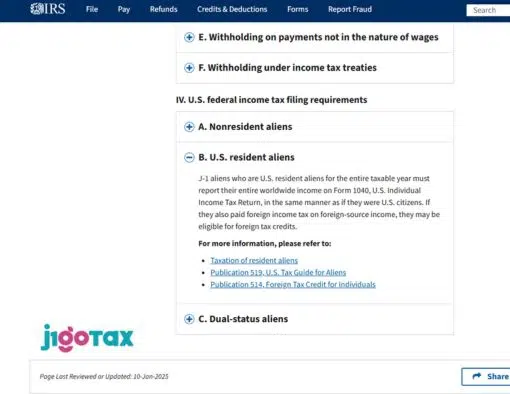
Source: IRS – Taxation of Alien Individuals (Section J-1)
https://www.irs.gov/individuals/taxation-of-alien-individuals-by-immigration-status-j-1“J-1 aliens who are U.S. resident aliens for the entire taxable year must report their worldwide income on Form 1040.”
— IRS, Taxation of Alien Individuals by Immigration Status — J-1, Section BSo let’s be clear:
✔ A J1 visa holder can file Form 1040
✔ In some cases, the IRS requires Form 1040
✔ Companies that say “J1 = 1040NR only” are wrong
✔ Confusion exists because many people don’t understand IRS residency rules
This article breaks everything down using only IRS-verified information — no myths, no fear, no shortcuts.

The Tax Moves Blog
Why This Topic Is So Confusing (And Why Companies Mislead J1 Workers)
Most J1 workers are young, international, and unfamiliar with the U.S. tax system.
Many companies take advantage of that uncertainty:
-
“If you file 1040, you’ll get in trouble.”
-
“J1s must only file 1040NR.”
-
“Form 1040 is only for U.S. citizens.”
❌ All of these statements are false.
❌ None of them match IRS documentation.
The confusion comes from one fact:
→ A J1 visa is a visa type.
→ But the IRS cares about tax residency status, not visa type.
That single difference changes everything.
IRS Rule #1: Nonresident Aliens Must Use Form 1040NR
This is the rule everyone already knows:
-
Most J1 workers are considered nonresident aliens
-
Therefore, they must file Form 1040NR
This applies to:
-
Cultura exchange J1s
-
Summer Work & Travel
-
Lifeguards
-
Hospitality workers
-
Camp counselors
-
Seasonal workers
-
J1s staying only a few months
👉 https://j1visataxes.com/j1-visa-tax-return-guide/
Good. Simple. Clear.
But here’s what almost no one explains…
IRS Rule #2: Some J1 Visa Holders Become “Resident Aliens” and Must File Form 1040
This is where the game changes — and where Sprintax and many accountants get lost.
Directly from the IRS:
“J-1 aliens who are U.S. resident aliens for the entire taxable year must report their entire worldwide income on Form 1040.”
A J1 becomes a resident alien if:
-
They lose their “exempt individual” status
-
They pass the Substantial Presence Test
-
They stay multiple years
-
They return for a second program
-
They stay long-term under categories like trainees or interns
When that happens:
✔ The IRS requires a 1040, not a 1040NR
✔ Filing the wrong form can cause delays, penalties, and IRS letters
✔ Most companies ignore this rule completely
👉 https://j1visataxes.com/j1-visa-form-1040-vs-1040nr/

Who Are the J1 Visa Holders Most Likely to File Form 1040?
✔ J1 Interns (12–18 months)
✔ J1 Trainees (18+ months)
✔ J1 returning for a second summer
✔ J1 who stayed long enough to pass the Substantial Presence Test
✔ J1 who stayed into the next fiscal year
These J1 workers may NOT be “nonresidents” anymore — meaning they cannot legally file 1040NR.
This is the part 90% of companies ignore.
Filing the Wrong Form (1040 vs 1040NR) Can Damage Your Case
The IRS does not forgive “honest mistakes” if you file the wrong form.
Filing 1040NR instead of 1040 may cause:
-
Incorrect tax calculation
-
IRS review for worldwide income
-
Owed back taxes
-
Refund delays
-
IRS letters requesting correction
Filing 1040 instead of 1040NR may cause:
-
Refund denial
-
Incorrect withholding treatment
-
Additional penalties
-
Future immigration questions
This is why the right form matters.
The Real Problem: Most Companies Don’t Know IRS Residency Rules
Here is where you strike with authority:
Many tax companies — including well-known platforms — automatically assume:
“J1 = 1040NR always.”
They do this because:
-
It’s easier
-
It avoids responsibility
-
They don’t train staff on IRS residency rules
-
They avoid explaining world income
-
They rely on templates instead of knowledge
And worst of all…
Some companies use fear to keep J1 workers confused:
-
“No, you cannot use 1040.”
-
“The IRS will punish you.”
-
“You will lose your visa.”
None of this is based on IRS law.
The Only Correct Method: Let the IRS Decide Your Status
At J1 Go Tax, we don’t guess.
We don’t force you into 1040NR.
We don’t use fear.
We don’t hide IRS rules.
We follow the official IRS process:
- Determine if you are an exempt individual
- Check your exempt years
- Run Substantial Presence Test
- Verify your residency status for the entire taxable year
- Apply the correct IRS form: 1040NR or 1040
It’s simple:
→ You don’t choose your form.
→ Your employer doesn’t choose your form.
→ A software shouldn’t choose your form.
→ The IRS decides.
And we make sure you follow that decision.

Documents You’ll Need (With Interlinks for SEO)
-
DS-2019 — Your program dates
👉 https://j1visataxes.com/ds-2019-j1-visa/ -
W-2 — Your regular wages
👉 https://j1visataxes.com/form-w2-j1-visa/ -
Form 1042-S — Tax treaty or scholarship income
👉 https://j1visataxes.com/form-1042s-j1-visa/ -
Form 8843 — Required for nonresidents
👉 https://j1visataxes.com/form-8843-j1-visa/
Examples: When Do J1 Workers Use 1040NR vs 1040?
✔ Example 1 — Summer J1 (3 months)
→ Nonresident → 1040NR
✔ Example 2 — J1 Intern (18 months)
→ Likely Resident → 1040
✔ Example 3 — J1 returning for a second year
→ Resident → 1040
✔ Example 4 — J1 with multiple stays
→ May lose exempt status → 1040
✔ Example 5 — J1 with 1042-S treaty benefits
→ Nonresident → 1040NR
Don’t Follow Myths. Follow the IRS.
For J1 visa taxes, the rules are not about:
-
software preference
-
a company’s template
-
what someone told you
The IRS has the final word.
And the IRS says clearly:
✔ Some J1 must file 1040NR
✔ Some J1 must file 1040
✔ Filing the wrong form creates problems
We help you file the right one — safely, correctly, and with full IRS compliance.
👉 Use our calculator and get your estimated refund in seconds:
https://j1visataxes.com/tax-calculator/
Core Guides & Calculators
1. Learn everything about J1 visa taxes — our complete 2026 step-by-step guide for nonresident workers with W-2 income.
2. Estimate your refund instantly with our J1 visa tax calculator — no signup required.
3. Compare Form 1040 vs 1040NR for J1 visa holders and find out which one applies to you.
4. Understand the importance of your DS-2019 form — it defines your program, tax status, and eligibility.
Forms & Tax Documents
5. Did you receive a 1099 instead of a W-2? Here’s what to do — Form 1099 for J1 visa workers explained.
6. Learn how to apply for your SSN or ITIN as a J1 visa holder before filing your taxes.
7. Understand your IRS transcripts for J1 visa taxes — what they show and how to request them.
8. Received a Form 1042-S? Discover what it means and how to include it in your tax return.
9. Find your Form W-2 for J1 visa — and learn what each box means when you file.
10. File correctly using the official Form 1040NR for J1 visa holders — step-by-step.
11. Don’t forget your Form 8843 — it’s mandatory even if you had no income.
12. Check this J1 visa tax return example using Form 1040NR to understand how everything fits together.
Special Cases & IRS Resources
13. Missed the April deadline? Learn how to file J1 visa taxes after April and still get your refund.
14. Review official IRS guidance on Taxation of J-1 visa holders and resident status.
You may also like

Do J-1 Visa Holders Pay State Taxes? A State-by-State overview
Do J-1 Visa Holders Pay State Taxes?Yes. J-1 visa holders generally must pay federal and state income tax on U.S.-source income. State rules differ: some tax any income earned in the state (nonresident sourcing), some tax residents on worldwide income, and a few states have no personal income tax at…

Substantial Presence Test for J-1 Visa Taxes – 1040NR or 1040 Explained
Substantial Presence Test for J-1 Visa Taxes: Resident vs Nonresident StatusThe Substantial Presence Test J-1 Visa Taxes is the IRS rule that determines whether a J-1 visa holder is classified as a nonresident alien or resident alien for U.S. tax purposes.This classification directly affects which tax form you must file…

J-1 Visa Taxes in Orlando – Guide for W-2 Workers Only
J-1 Visa Taxes in Orlando: What You Should KnowOrlando, Florida, hosts thousands of J-1 exchange visitors with Form W-2 income only, especially through programs connected to theme parks, hospitality, tourism, hotels, restaurants, retail, and cultural exchange organizations across Central Florida. Most employers in Orlando pay J-1 workers through standard W-2…

IRS Announces First Day of 2026 Tax Season – Filing Dates & Tools
IRS Announces First Day of the 2026 Tax SeasonThe Internal Revenue Service (IRS) has officially announced that January 26, 2026 will be the first day of the 2026 tax filing season. Starting on this date, the IRS will begin accepting federal tax returns for the 2025 tax year. This announcement…

J-1 Visa Taxes in South Bay – Guide for W-2 Workers Only
J-1 Visa Taxes in South Bay: What You Should KnowSouth Bay, including areas such as Torrance, Redondo Beach, Manhattan Beach, Hermosa Beach, Hawthorne, and El Segundo, hosts many J-1 exchange visitors with Form W-2 income only. Participants commonly work in hospitality, tourism, aviation, technology support, universities, retail, and service industries…

J-1 Visa Taxes in Long Beach – Guide for W-2 Workers Only
J-1 Visa Taxes in Long Beach: What You Should KnowLong Beach, California, hosts thousands of J-1 exchange visitors with Form W-2 income only, particularly through programs connected to ports and logistics, hospitality, tourism, universities, healthcare facilities, retail, and service industries across Los Angeles County. Most employers in Long Beach pay…

J-1 Visa Taxes Central Valley – W-2 Workers Only
J-1 Visa Taxes in Central Valley: What You Should KnowCalifornia’s Central Valley is home to a large number of J-1 exchange visitors with Form W-2 income only. Each year, non-resident workers are employed across agriculture support services, food processing, logistics, hospitality, education programs, healthcare assistance, and seasonal operations in cities…

J-1 Visa Taxes in Fresno – Guide for W-2 Workers Only
J-1 Visa Taxes in Fresno: What You Should KnowFresno and California’s Central Valley host a significant number of J-1 exchange visitors with Form W-2 income only each year. Participants work mainly in agriculture support services, food processing, hospitality, education programs, healthcare assistance, cultural exchange roles, and seasonal employment across Fresno…

J-1 Visa Taxes in Ventura, CA: What You Should Know
J-1 Visa Taxes in Ventura: What You Should KnowVentura and the surrounding coastal areas host a steady population of J-1 exchange visitors with Form W-2 income only each year. Participants are employed mainly in hospitality, coastal tourism, restaurants, seasonal services, agriculture support roles, cultural exchange programs, and education-related employers across…

J-1 Visa Taxes in Santa Bárbara – Guide for W-2 Workers Only
J-1 Visa Taxes in Santa Bárbara: What You Should KnowSanta Bárbara and the Central Coast welcome thousands of J-1 exchange visitors employed by beach resorts, university programs, seasonal tourism businesses, and healthcare training centers with Form W-2 income only each year. Most employers in Santa Bárbara pay J-1 participants through…